



IT Policies & Procedures
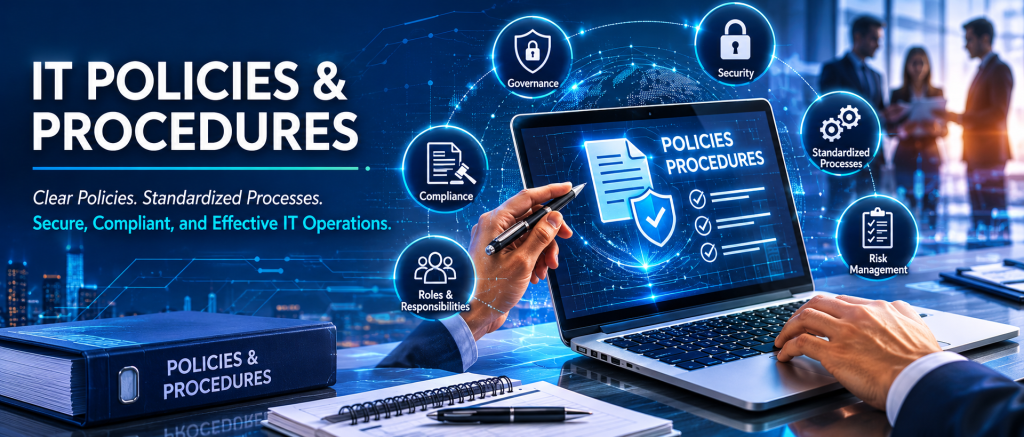
Establishing the Foundation for Effective IT Governance and Operational Excellence
As organizations grow entirely dependent on technology, the need for clear governance, consistent operations, and strict regulatory compliance is no longer optional—it is a business imperative. Well-defined IT policies and procedures provide the essential framework for how technology resources are managed, protected, and utilized to drive organizational value.
IT Policies establish the rules, principles, and strategic boundaries for technology governance.
IT Procedures provide the granular, step-by-step instructions required to execute those policies consistently and efficiently.
Together, they transform chaotic, ad-hoc workflows into a structured environment that minimizes risk, ensures compliance, and accelerates business objectives.
The Cost of the Status Quo
Without a unified IT policy and procedure framework, organizations routinely face critical operational bottlenecks:
Siloed, inconsistent practices across different departments and teams.
Ambiguous roles and responsibilities, leading to dropped tasks or duplicate efforts.
Spike in cybersecurity vulnerabilities and preventable operational risks.
Compliance exposure and potential penalties from failing to meet regulatory standards.
The “Hero” Dependency: Institutional knowledge trapped in the heads of a few individuals rather than documented in organizational processes.
Friction-heavy onboarding for new employees and third-party vendors.
Our Methodology
We don’t build shelf-ware. We design practical, business-aligned IT policies and procedures that are easy to understand, simple to maintain, and seamlessly integrated into daily workflows.
[Assessment] ──> [Framework Design] ──> [Development] ──> [Alignment & Governance]
Current-State Assessment: We audit your existing documentation, baseline governance, and regulatory requirements to uncover immediate gaps, overlaps, and operational risks.
Framework Design: We map out a structured hierarchy aligned to your specific business objectives, industry standards (e.g., ISO, NIST, COBIT), and compliance mandates.
Policy & Procedure Development: We author clear, high-level governance policies alongside detailed, tactical operational procedures to ensure absolute accountability.
Stakeholder Alignment: We collaborate directly with your business and technical teams to validate that the new documentation is practical and reflects real-world operations.
Lifecycle Governance: We establish clear document ownership, realistic review cycles, and approval workflows so your documentation evolves alongside your technology.
Core Operational Pillars Covered
| Pillar | Scope & Focus Areas |
| IT Governance | Strategy alignment, decision-making authorities, roles & responsibilities, IT oversight. |
| Information Security | Access control, password hygiene, data classification, and proactive cybersecurity controls. |
| IT Operations (ITSM) | Incident, problem, change, capacity, and service request management. |
| Infrastructure & Cloud | Network management, sysadmin guardrails, cloud governance, and asset tracking. |
| Risk & Compliance | IT risk frameworks, regulatory mapping, audit readiness, and third-party risk. |
| BC / DR | Business continuity planning, disaster recovery execution, and resilience testing. |
| App Management | SDLC standards, implementation controls, QA testing, and release management. |
Key Deliverables
IT Governance Framework & Policy Library: A centralized, organized repository of all high-level organizational IT policies.
IT Operational Procedures Manual: Actionable, step-by-step documentation for daily engineering and support workflows.
RACI Matrix: Explicitly defined roles, responsibilities, and ownership lines.
Compliance Mapping Matrix: A cross-reference tool mapping your internal controls directly to external regulatory requirements.
Lifecycle Management Plan: Automated review workflows, approval structures, and communication plans to drive organizational adoption.
The Strategic Return
Operational Excellence as a Competitive Advantage
A robust policy framework doesn’t slow down innovation—it accelerates it by providing clear guardrails.
By standardizing your IT landscape, your organization unlocks immediate, compounding benefits:
Enhanced Risk Mitigation: Drastically lower cybersecurity and operational exposure.
Audit Readiness: Continuous compliance that simplifies internal and external audits.
Predictable Service Delivery: Consistent IT service quality and improved user experiences.
Scale-Ready Operations: Rapid onboarding and seamless knowledge transfer that eliminates key-person dependencies.
Strategic Alignment: An IT organization tightly engineered to support long-term business growth.